

Overview
Husker Rocketry is a student-run team that designs, builds, and launches high-powered rockets at the Intercollegiate Rocket Engineering Competition (IREC). We learn about aerodynamics, composite material fabrication, avionics, and telemetry. A unique scientific research payload is created each year and launched in the competition rocket. Members of this team gain valuable hands-on engineering skills that allow them to pursue aerospace internships and careers.

Sauron was the rocket that competed in the 10k Commercial Off-The-Shelf (COTS) category at IREC in Midland, Texas. A major highlight was the custom telemetry payload, which transmitted live GPS data throughout the flight, alongside the in-house fabrication of fiberglass and carbon fiber tubes and fins. We also integrated a Raspberry Pi for live video streaming, captured via a ground station dish. This year, we further developed our composite manufacturing skills and successfully collected both flight data and real-time video from the rocket.
Airframe
This past year, our Airframe Subteam made huge strides in mastering composite fabrication and teamwork. We learned how to create fiberglass and carbon fiber tubes and fins, focusing on fabric-to-resin ratios and the precision needed in preparing fabric for layups. Through trial and error, we tackled the challenge of removing tubes from the mandrel and even designed and built a custom mandrel to improve our process. Along the way, our team collaborated closely during layups, gaining hands-on experience and refining skills that will strengthen our future designs and builds.


Payload
The CAD for this year's payload was completed using SolidWorks. It was designed to ensure all electronics would fit within the limited amount inside the coupler, using PETG as the filament for the physical construction of the payload. We chose this layout of components to make wiring easy and streamlined.
The payload for the 2024-2025 year was a video livestream from the rocket to the ground. This included coding a ground station that consisted of a satellite dish rotator to receive live video and a program to interface with it. The payload materials included COTS (commercial off-the-shelf) electronics and radios donated by one of our sponsors, Taisync.
Our avionics system utilized dual Featherweight Blue Raven flight computers as the primary and secondary avionics, providing redundancy and reliable deployment control. Both Blue Ravens feature Bluetooth connectivity, allowing for wireless configuration and monitoring. As a tertiary backup, we integrated a TeleMetrum unit, which not only provided an additional layer of charge deployment capability but also supplied GPS tracking for real-time location and recovery support.




Media & Marketing
Our Media and Marketing leads played a crucial role in expanding the visibility and support of our club this past year. They actively reached out to numerous companies and organizations, presenting the club's missions, technical goals, and community impact in a professional manner that successfully secured several sponsorships and partnerships.
Beyond sponsorship outreach, they established a digital presence by creating and managing the club’s official Instagram and LinkedIn accounts, which have become key tools for sharing the team's journey. These posts include updates on each subteam’s progress, introductions to leadership members, and coverage of both local and international launch events. They combined professional outreach with consistent and engaging content, helping the team build a strong foundation for long-term growth, industry connections, and greater public engagement with the club's work.

2023-2024
Battle of the Rockets
Objective: Build three different rockets: Mars Pathfinder Lander, Deployable Sensor Payload Event, and Target Altitude Event.
1. Mars Pathfinder Lander: A rocket that contains a rover as its payload. Once the rocket lands, the rover will release from the nose cone and take a picture of the payload that it left.
2. Deployable Sensor Payload Event: A rocket that, rather than using a parachute to descend, will use a passive helicopter as its recovery as its payload. The ground station will also capture transmitted data from the payload and display the sensor data in real-time. This rocket uses a commercial G motor.
3. Target Altitude Event: A rocket where the length to airframe ratio shall be no longer than 4 to 1, and will reach as close to 900 feet using a commercial F motor. The rocket must perform two successful flights or be disqualified. The airframe must also be at least 50% 3D printed.
Level 1 High-Powered-Certification
To get members hands-on experience and become acquainted with the basics of rocket engineering, Husker Rocketry teaches its members how to build certification rockets to become level 1 high-powered-certified for high-powered rocket motors. This allows members to get experience with rocket design, simulations, machining, and assemblies. The team uses OpenRocket and SolidWorks as its primary software for design and simulation.


From left to right are rockets from the Deployable Sensor Payload Event, Mars Pathfinder Lander, and the Target Altitude Event.
2022-2023
Spaceport America Cup
From 2022-2023, the team chose to participate in the Spaceport America Cup competition, the world’s largest intercollegiate rocket engineering conference and competition. The rocket, named EVE, is 9.08 feet long and has a 6.17-inch diameter. Powered by a commercially produced motor, EVE reached a target altitude of 10,000 feet.
The payload revolved around the survivability of corn sprouts through a launch to 10,000 feet and the continued viability of the sprouts. The sprouts were grown in rock wool cubes using hydroponics until they reached 2-3 weeks. Half of the sprouts were planted in the rocket and launched to 10,000 feet, while the others were grown in a controlled environment.
At the competition, the team placed 39th out of 119 teams. The team also placed 25th in the 10k COTS motor category.

Members
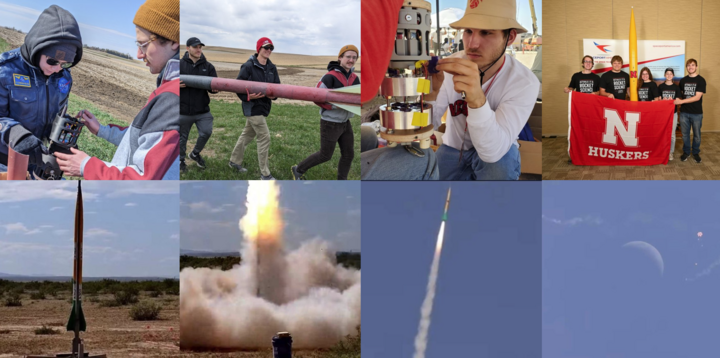
The team has a place for anyone interested in building their knowledge about rocketry and aerospace engineering. Members who like crunching numbers and predicting the future find their niche in the design of our rockets’ brains: the payload. Members who prefer a more tactile focus can put their skills to the test through the precision construction of rockets that must withstand extreme flight conditions. And, a love for making things that go fast and high is the common bond that all team members share. However, Husker Rocketry is much more than a club for enthusiasts. We are proud of the considerable number of our members who can say they have interned for NASA, in part due to their hands-on experience gained from the team.
2025-2026 Leads
Amber Tannehill - Co-President
Nyk Harms - Co-President
Khanh Le - Co-Airframe Lead
Alex Rien - Payload Mechanical Lead
Manas Moondra - Payload Programming Lead
Killian Haecker - Social Media / Marketing Lead & Co-Airframe Lead
Caleb Hans - Avionics Lead