Regional Significant Events for March - May 2025
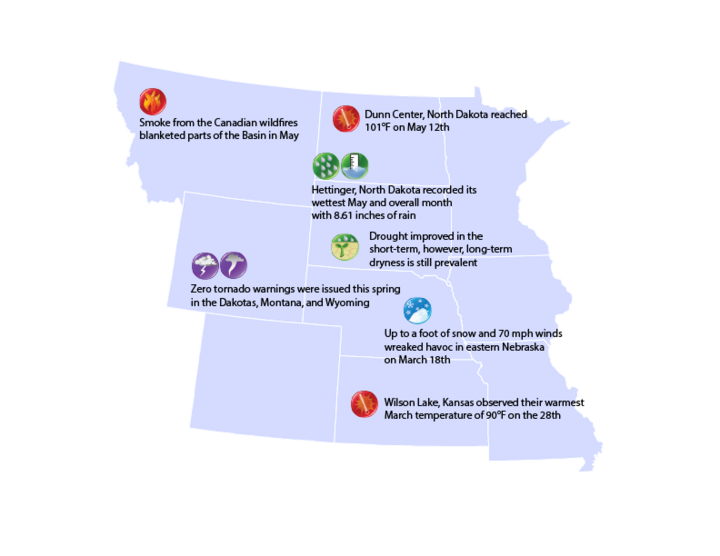
Highlights for the Basin
An intense severe weather outbreak impacted Kansas and Nebraska on May 18th, with over a dozen tornadoes touching down. Seven EF3s would touch down in Kansas alone, the highest total of F3/EF3 or stronger tornadoes in a single day for the state since April 26, 1991. Despite multiple tornado emergencies and several towns being struck, only a few injuries were reported. Dry soils and gusty winds in March led to one of the deadliest dust storms in Kansas in recent history. Winds reached over 50 mph on the 18th, leading to near-zero visibility between Colby and Goodland. The blinding conditions created a 71-car pileup, with eight fatalities reported. These would be the first fatalities due to dust in the area in over a decade.
Regional Climate Overview for March - May 2025
Temperature and Precipitation Anomalies
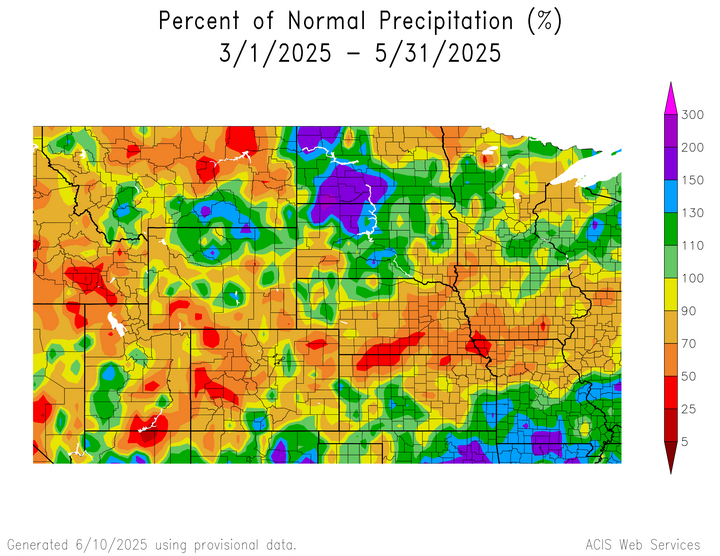
Spring began on a warm note, with dozens of counties in Kansas, Nebraska, and South Dakota ranking in the top 5 warmest. Temperatures in April were near normal, while May was above normal in the northern Missouri Basin states due to a unseasonably warm three day stretch in the early part of the month. Precipitation was above normal in the western parts of the Dakotas this spring due to abundant rainfall in the back half of May. Snowfall in March was exceptionally high across northern Wyoming, with over 5 feet falling in some areas. April was very dry in Nebraska and eastern Wyoming, with less than half an inch of precipitation in some areas.

| 
|
Changes in Drought Conditions

The map above shows the areas of increasing (yellow shading) and decreasing (green shading) categories of drought. Up to 4 classes of improvement occurred across northern Wyoming, with drought nearly removed in the area. Northern Montana was the opposite this spring, with up to 3 classes of degradation.
Regional Impacts for March - May 2025
Agriculture
Soil moisture in North Dakota drastically improved after the heavy rains in May. The same cannot be said for Montana, where 61 percent of topsoil moisture was rated poor to very poor. Spring wheat had a historically poor start, with one of its worst initial ratings. Winter wheat yields are projected to be down over 15 bushels an acre in Nebraska and South Dakota.

Wildfires
The dryness plaguing the region since last fall led to thousands of acres burned across the Basin. Nearly 34,000 acres were burned in the Cheyenne River fire in March, while numerous smaller wildfires were reported on a daily basis. Towards the end of May, smoke drifting down from wildfires in Canada led to air quality issues and visibility reduced to less than 100 yards in North Dakota.

Water Resources
Warmer temperatures in the west led to a rapid snowpack melt-off in the Rockies this spring. According to the U.S. Army Corps of Engineers, runoff is projected to be 77 percent of normal, and lower releases along the Missouri River are expected this summer. Despite the heavy May rainfall in North Dakota, there was no flooding reported.

MO River Basin Partners
High Plains Regional Climate Center
www.hprcc.unl.edu
National Integrated Drought Information System
https://www.drought.gov/
NOAA NCEI
www.ncdc.noaa.gov
NOAA NWS – Central Region
www.weather.gov/crh
NOAA NWS Climate Prediction Center
www.cpc.ncep.noaa.gov
NOAA NWS Missouri Basin River Forecast Center
www.weather.gov/mbrfc
American Association of State Climatologists
https://www.stateclimate.org/
U.S. Army Corps of Engineers
www.nwd-mr.usace.army.mil/rcc/
U.S. Bureau of Reclamation
https://www.usbr.gov/
USDA Natural Resources Conservation Service
www.nrcs.usda.gov
USDA Northern Plains Climate Hub
www.climatehubs.oce.usda.gov
Bureau of Indian Affairs – Great Plains Region
www.bia.gov/regional-offices/great-plains
National Drought Mitigation Center
http://drought.unl.edu/