Content
Current Projects
Interested in collaborating on a data analysis project? Please contact me at kaycie.lane@unl.edu
Previous Projects
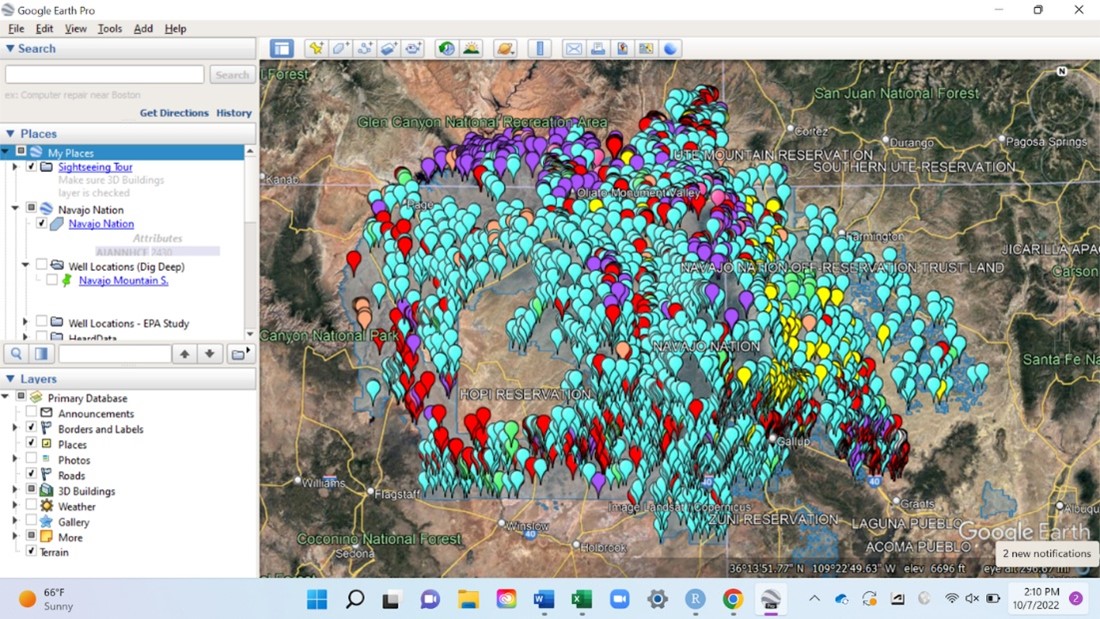
Map of DigDeep Well Sites
Through connections to the Working Access Coordination Group started by the United States Public Health Service (USPHS), I have connected with DigDeep, a non-for profit working to provide water access to underserved communities in the United States. I collaborated with staff at DigDeep to help map out where wells are located on the Navajo Nation, using data from previous studies and entering data in GoogleMaps. Below is a map showing the types of wells present. While advanced tools like ArcGIS exist for mapping data, the purpose behind this collaboration was to make a map that anyone could use and access within the organization to quickly talk about potential wells in the Navajo Nation.
Aquaculture Upflow Biofilter Design
I worked with Nebraska Vegetable and Protein in Summer 2023 to design and size an upflow biofilter to treat nitrogenous waste from a new aquaculture facility located in Nebraska City. The result of the project was not only sizing information on different biofilters, but an Excel spreadsheet model that can be used to size biofilters for a variety of facility sizes and types. A memo explaining the model and the Excel Model itself can be found below as an example of this work.
Memo
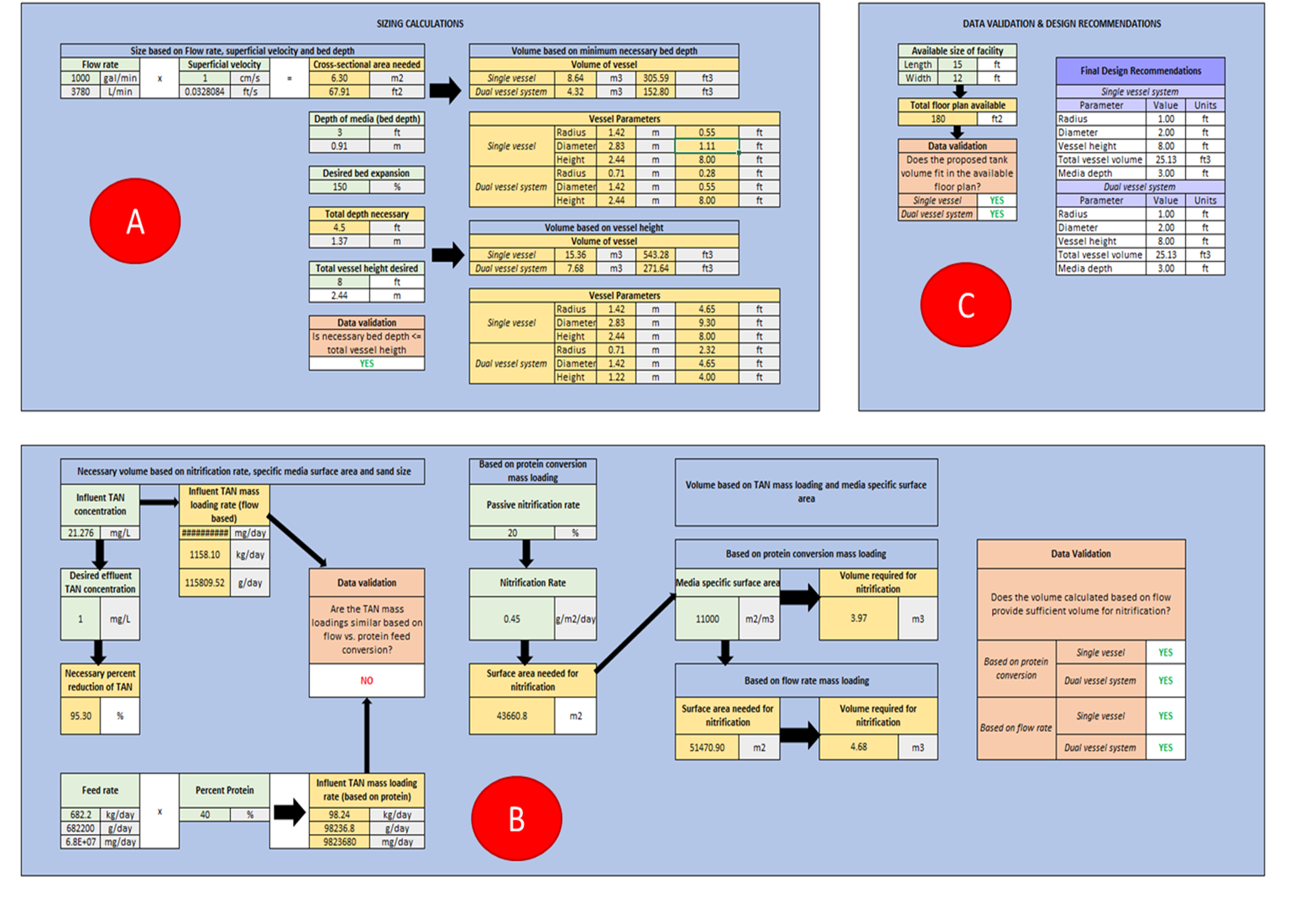
The key for the Excel model is as follows: Inputs are in green, calculated values are in gold, data validation checks are in orange and design recommendations are presented in purple. Some green inputs are drop down boxes and some are data input boxes. Please check the units of each box before entering a number. The model is set to automatically update the calculations based on user inputs to the model.
In section A of the Excel Model, flow rate, velocity, bed depth and bed expansion are used to size a single vessel and a dual vessel upflow biofilter system. Inputs in green include flow rate, superficial velocity, depth of media, desired bed expansion and total vessel height desired. Cross sectional area is calculated by dividing the flow rate by the superficial velocity. The height of the vessel is found by calculating the necessary height using both bed depth and bed expansion. The necessary bed depth is checked against the desired vessel height in the data validation box and if the amount of media necessary is less than the desired height, the design passes the data validation box. The desired vessel depth is then used in conjunction with the calculated cross-sectional area to find the volume of a cylindrical vessel for both a single and dual vessel system. The radius and diameter of the vessels are found by using the volume and desired vessel height.
In Section B, TAN mass balance calculations are used to verify the volume of media necessary for treatment in the aquaculture system. If the volume of media necessary for nitrification is smaller than the volume calculated via flow rates, then the volume of media necessary based on flow rates will be used to size the system. The purpose of section B is to verify that the volume of media found in section A is sufficient for the mass loading of TAN to the system. There are two different methods of calculating mass loadings: (1) using the concentration of TAN and flow rates from section A and (2) using the mass of feed and doing a mass balance on nitrogen and TAN. Section B is set up to calculate both methods and compare the two, ultimately finding a volume using the higher of the two numbers. The mass loadings (in g/day) are multiplied by a nitrification rate to find the necessary surface area of media required. This surface area is then divided by a media specific surface area to determine the volume of media necessary to complete nitrification. The volume obtained from this calculation is then checked against the volume found in section A in the data validation box.
In Section C, the known footprint of the facility is used to check whether the designed filter vessels will fit in the allotted space. If the vessel size will fit in the allotted space, the “Final Design Recommendations” table is populated with the values obtained for sizing in section A, with each value rounded up to the nearest whole number.